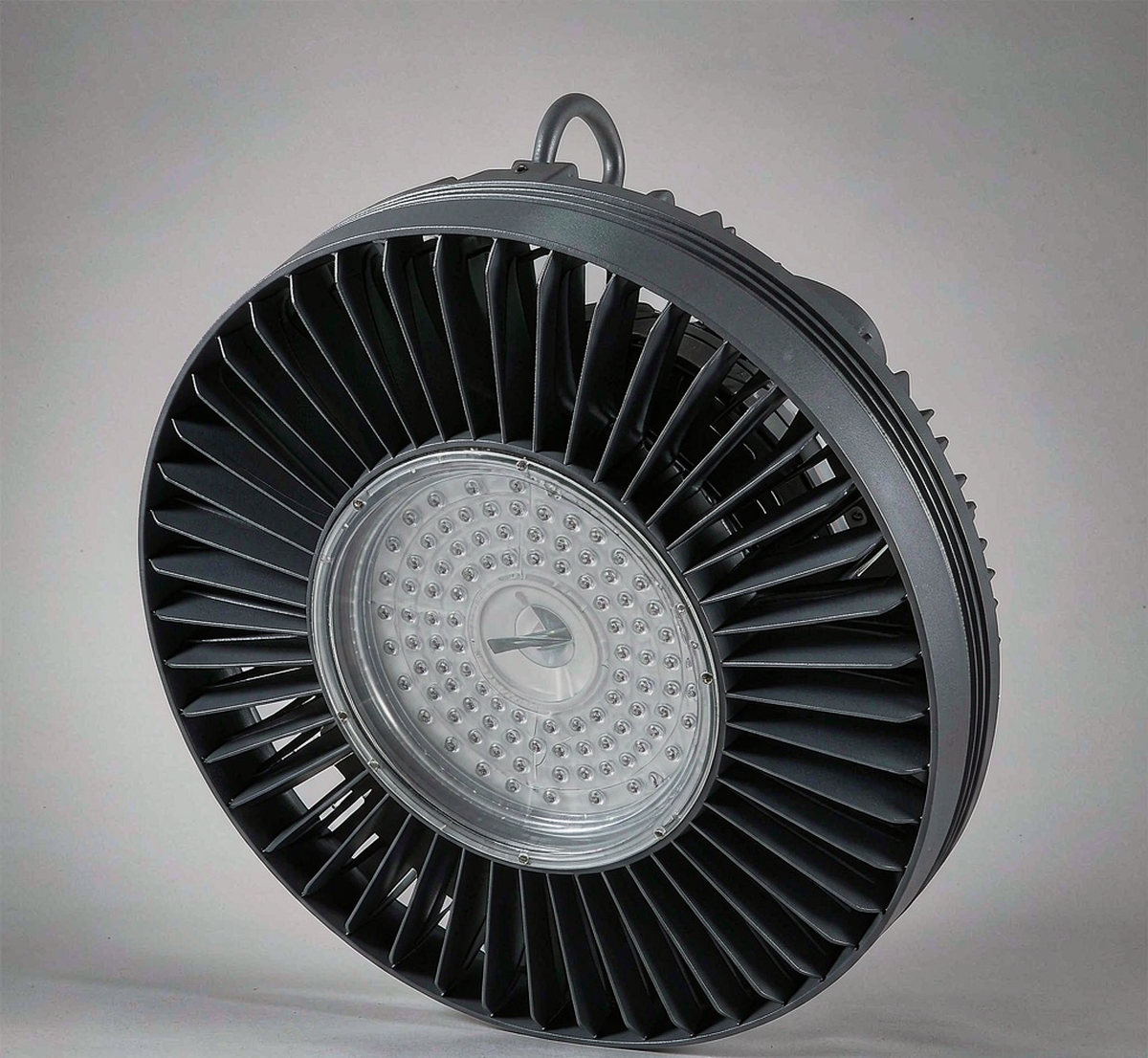
LED High Bay Buying Guide: 100W, 150W or 200W?
Wattage is the last decision, not the first. Start from the mounting height, the task and the target illuminance, then work back to watts.
Mounting height sets the beam angle
- 4–6 m — 90° or 120° beam, 100W class. Wide coverage, low ceiling aisles.
- 6–9 m — 90° beam, 150W class. The most common warehouse figure.
- 9–12 m — 60° or 90° with a narrow reflector, 200W class.
- Above 12 m — 45–60° optics and 200–300W, or linear high bays on trunking.
Target illuminance
EN 12464-1 asks for 100 lux on storage aisles, 150–200 lux on picking faces and 300 lux for inspection benches. A 150W UFO at 8 m with 90° optics typically delivers 120–150 lux on a 6 m grid at 0.7 maintenance factor.
Efficacy is where the savings are
Two 150W fixtures can differ by 25% in delivered lumens. Insist on system efficacy (luminaire, not chip) of at least 130 lm/W and ask for the LM-79 report for the exact model, not the family.
Heat, not wattage, kills high bays
In a 45°C plant a die-cast housing with a well-designed fin stack will hold junction temperature below 75°C; a thin stamped housing will not. Ask for the Tc point measurement and the driver brand — Mean Well, Philips or Sosen rather than unbranded.
What we supply
UFO high bays from 100W to 300W, 130–150 lm/W, IP65, with optional 0-10V or DALI dimming, motion sensors, reflectors and hooks. High-temperature versions for foundries and glass plants are available on the same tooling.